ADHD and Language Learning: Why Classes Don't Always Work

I've spent roughly 25 years living abroad, and languages have been a central part of my life for as long as I can remember. I've studied them, spoken them, struggled with them, and taught them as a university professor. These days, I also work with expats in Germany who are trying to learn German while navigating everything else that comes with building a life in another country. And one thing has always fascinated me: Being good at studying a language and being good at speaking it are not necessarily the same thing.
Some people can explain complicated grammar rules, write almost flawless sentences, and pass exams with excellent grades. Yet when someone unexpectedly asks them a question in the supermarket, they freeze. Others make grammatical mistakes in almost every sentence but somehow manage to make friends, solve problems, and communicate perfectly well. So who's better at the language? And what happens when ADHD enters the picture?
Why some people with ADHD seem to learn languages effortlessly
For some people with ADHD, learning a new language can be incredibly exciting. There's always something new to discover: unfamiliar sounds, expressions, cultural differences, and the wonderful moment when you suddenly understand something that would have been completely incomprehensible a few weeks earlier. Learning a language can offer exactly the kind of novelty, challenge, and immediate feedback that some ADHD brains find particularly motivating. You learn a new phrase, try it out, and someone understands you. Success! That can be much more rewarding than memorizing a vocabulary list for an exam next Thursday. But does ADHD actually make people better language learners?
The research is more nuanced. In a 2024 study of 59 adults with ADHD, researchers found considerable variation in how participants experienced learning and using additional languages. Some described difficulties with attention, memory, or particular language skills, while others identified strategies that helped them learn effectively. The interesting finding wasn't that ADHD automatically made language learning easier or harder. It was that people often reached their goals through different approaches. And that matches what I've observed: The question isn't simply whether someone with ADHD can learn a language. It's what makes them want to keep learning.
Why traditional language classrooms don't work for everyone
Having taught languages at university, I know that language courses can be excellent. A good teacher provides structure, introduces new concepts gradually, gives feedback, and creates opportunities to practice. For people who struggle with organization, having a regular class can be enormously helpful. But I've also seen the limitations.
Language textbooks often revolve around manufactured situations. Students discuss imaginary vacations, describe fictional families, or practice ordering meals from menus that don’t appeal to them. There's nothing inherently wrong with these exercises. They provide useful vocabulary and predictable opportunities to practice. But sometimes they're simply boring. And for someone with ADHD who struggles to engage with material that feels irrelevant, that can be a serious obstacle.
Compare discussing an imaginary weekend trip with a classmate to trying to explain to someone you've just met why you moved to their country. The second conversation might be much more difficult. You might make mistakes, forget words, or struggle to understand the response. But suddenly the language matters. You're communicating something about yourself. You're curious about the other person. You genuinely want to understand what they're saying. The language has become a means of connecting with someone rather than an exercise to complete.
Hyperfocus on the language but not on the grammar
One of the fascinating contradictions of ADHD is that someone who struggles to concentrate on a grammar worksheet may spend hours exploring a language they love. They might become absorbed in a television series, investigate the meaning of song lyrics, or spend an entire evening learning expressions associated with a particular hobby. But ask them to complete twenty exercises on verb endings, and suddenly they can't get started.
This doesn't necessarily mean grammar is unimportant. Grammar helps us understand how a language works. It can make communication more precise, reduce misunderstandings, and help us move beyond basic conversations. But grammar exercises are not the only way to learn grammar. Some learners enjoy understanding the underlying rules. Others find it easier to recognize patterns through repeated exposure to conversations, stories, and meaningful situations.
Personally, I've always found the connection between language and culture particularly motivating. Learning Japanese wasn't simply about memorizing vocabulary. It was about understanding a completely different world. That curiosity made the effort worthwhile. And I think this distinction matters for ADHD: Interest can help us engage with difficult material, but that doesn't mean we automatically enjoy every part of the learning process.
Immersion versus textbooks: What actually works?
When I lived in Japan, Denmark, and later the United States, language learning wasn't confined to a classroom. It happened while shopping, making friends, dealing with everyday problems, and trying to understand what people were talking about. Sometimes those experiences were exhausting, particularly in Japan, where the language was so different from the European languages I already knew. But they also gave me something textbooks couldn't always provide: a genuine reason to communicate. I wasn't practicing a conversation because it appeared on page 47. I was speaking because I wanted something, needed information, or was interested in another person.
Research supports the value of meaningful language use. A meta-analysis of 52 studies on task-based language teaching found positive effects on language learning outcomes. Task-based approaches emphasize using language to accomplish meaningful goals rather than concentrating exclusively on isolated forms. Of course, this doesn't mean immersion automatically works better than classroom learning. Simply living in another country doesn't guarantee that you'll learn the language. You can spend years surrounded by German and still speak mostly English. And classroom learning can incorporate meaningful conversations and real-life tasks. I think the most useful approach is often a combination: enough structure to understand what you're learning, and enough authentic interaction to make you want to use it.
Does passing a language exam mean you can speak the language?
This is something I've thought about frequently as a former professor. Exams measure particular skills under particular conditions. A written grammar test may tell us whether someone understands verb conjugations or sentence structure. A listening examination may assess comprehension. An oral exam can evaluate certain aspects of speaking. All of these skills matter. But they don't necessarily tell us how someone will communicate in everyday life.
I've encountered people who are extremely careful about grammatical accuracy but become so concerned about making mistakes that spontaneous conversation feels almost impossible. Others speak with remarkable confidence despite making plenty of errors. They find alternative words, use gestures, ask questions, and keep the conversation going. Their grammar may be imperfect, but their communication works.
For people with ADHD, traditional testing can introduce additional challenges: time pressure, working-memory demands, anxiety, or difficulty sustaining attention during repetitive exercises. A disappointing test result therefore doesn't necessarily reflect someone's full communicative ability. At the same time, being able to communicate comfortably doesn't mean grammar and accuracy are irrelevant, especially in professional or academic settings. We need both perspectives. Language proficiency isn't one single skill, and no single test captures everything a person can do.
Learning German when you're already overwhelmed
I see another dimension of this challenge in my coaching work with expats living in Germany. Many people arrive with enormous motivation. They want to integrate, make friends, find work, and feel at home. They sign up for German classes, buy textbooks, download apps, and promise themselves they'll practice every day. But they're also dealing with paperwork, unfamiliar systems, work responsibilities, and the emotional challenges of moving abroad. Learning German becomes one more demand in an already demanding life. And German grammar doesn't exactly make things easier. Articles, cases, adjective endings, word order — there's a lot to remember.
For someone with ADHD, keeping up with homework, attending classes regularly, and organizing independent study can be as challenging as learning the language itself. Sometimes the problem isn't a lack of motivation. It's that the learning process has become disconnected from the person's actual life. Someone who loves cooking might learn more enthusiastically by following German recipes or visiting a local market. Someone interested in sports might benefit from joining a club. Someone who enjoys conversations might progress through regular meetings with a language partner. The language becomes part of something they already care about.
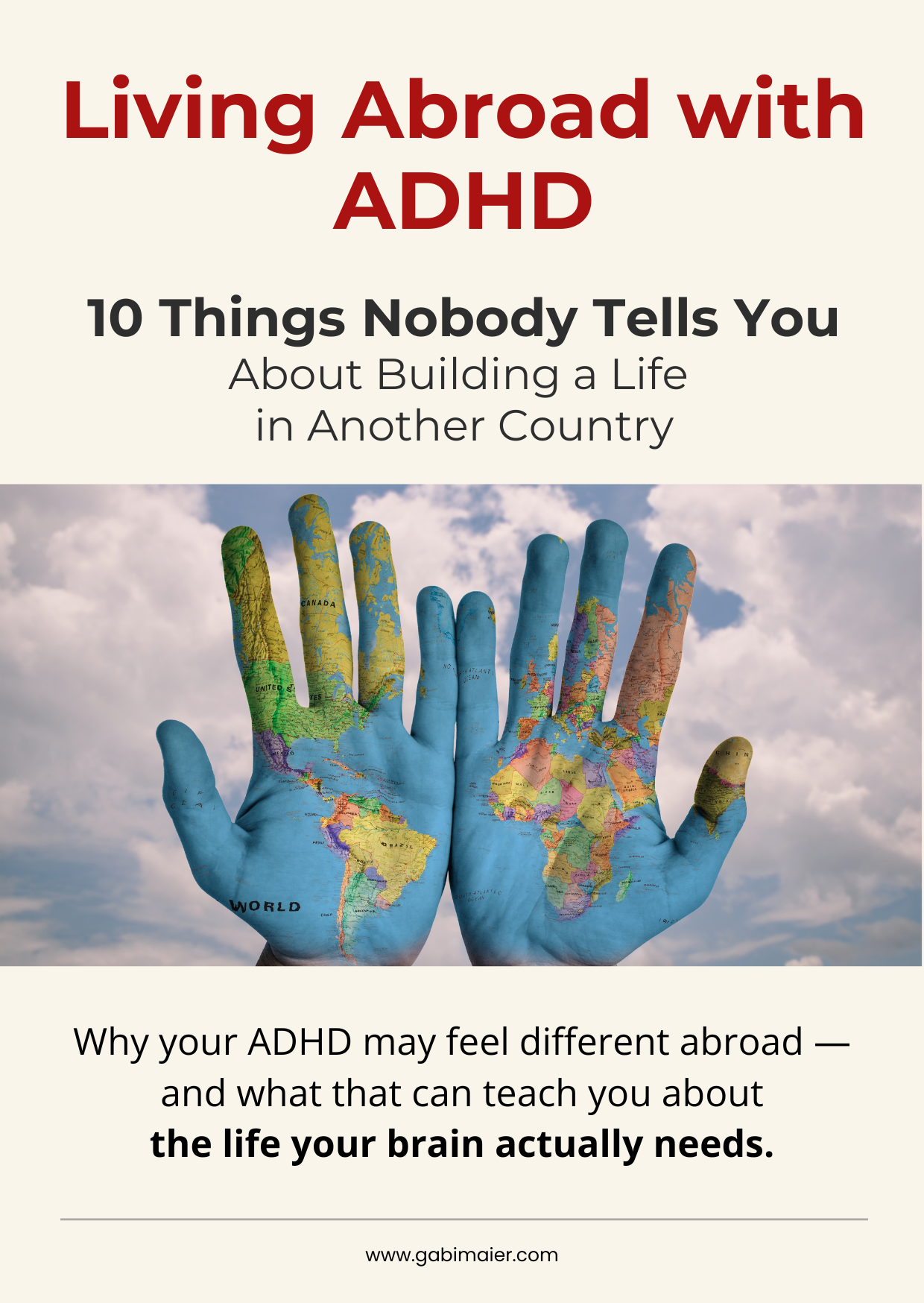
Learning a New Language Is Only Part of Moving Abroad
When you move to another country, you're not just learning new words. You're also adjusting to unfamiliar routines, expectations, relationships, and ways of doing things.
In my free guide, Living Abroad with ADHD: 10 Things Nobody Tells You About Building a Life in Another Country, I explore some of the less obvious challenges and unexpected opportunities of starting over somewhere new.
Get the free guide here
How to make language learning more ADHD-friendly
Rather than searching for the perfect language-learning method, I'd encourage people to experiment. A few approaches I particularly like:
Start with your interests. Read, watch, or listen to something you'd enjoy even in your native language.
Practice real conversations. Ask questions, tell stories, and use the language to accomplish something meaningful.
Learn grammar when you need it. If you keep making the same mistake, spend a little time understanding the rule and then practice using it.
Make practice manageable. Ten minutes of engaging practice may be easier to sustain than an hour of exercises you dread.
Use classes strategically. A course can provide structure and accountability, but it doesn't have to be your only learning environment.
Redefine progress. Notice when you understand a conversation, express an opinion, or handle a situation that previously felt impossible.
And perhaps most importantly, don't wait until your grammar is perfect before speaking. Making mistakes is part of learning.
Maybe we're measuring the wrong things
After years of learning and teaching languages, I've become increasingly interested in what actually helps people communicate. I still believe grammar matters. I still value good teaching, carefully designed courses, and structured learning. But I also believe we sometimes focus so heavily on correctness that we forget why people learn languages in the first place. We learn them to connect, understand, participate, work, travel, and build relationships.
For people with ADHD, finding a personal reason to engage with the language can make an enormous difference. Perhaps you don't need another vocabulary app or another workbook filled with exercises. Perhaps you need a conversation that makes you forget you're practicing. And maybe the next time you manage to explain something complicated in wonderfully imperfect German, you should recognize that for what it is: Real progress.
Frequently Asked Questions
Are people with ADHD naturally good at learning languages?
Not necessarily. ADHD affects people differently, and research doesn't establish that people with ADHD are generally better or worse language learners. Some find novelty and real-life communication motivating, while others struggle with attention, working memory, or consistent practice.
Why can language classes be difficult for adults with ADHD?
Traditional classes may involve repetitive exercises, lengthy explanations, homework, and limited opportunities for personally meaningful conversation. These demands can be challenging for some learners with ADHD. However, well-structured, interactive courses can also provide valuable support.
Is immersion better than studying grammar?
Neither approach is automatically superior. Immersion offers opportunities for meaningful communication, while explicit grammar instruction can help learners understand patterns and improve accuracy. Many people benefit from combining both.
Can I become fluent without perfect grammar?
Yes. Effective communication doesn't require flawless grammar. However, improving accuracy can make conversations clearer and becomes particularly important in professional, academic, or formal situations.
What's the best way to learn a language with ADHD?
Start with activities that are genuinely interesting and relevant to your life. Combine regular exposure, real conversations, manageable practice, and targeted grammar instruction. A class or language partner can provide structure and accountability when needed.
Did this article resonate with you?
If you often find yourself struggling with ADHD and would like some support, I'd be happy to help. Together, we'll develop practical strategies that fit your life, your strengths, and your goals. In a free 30-minute consultation, we'll explore whether my approach is the right fit for you.
For teenagers (15+) and adults.
Enjoyed this article?
Every other week, I publish a new article with evidence-based insights and practical strategies to help you better understand and manage ADHD in everyday life.