I Was Fine in School. So Why Am I Struggling in College?

Everything seemed fine in school. You got good grades. You graduated, even though those last couple of years were sometimes pretty exhausting. Maybe you were a little chaotic, you routinely prepared presentations the night before, or finished your homework during lunch break. But somehow, it worked.
And then you started college, and suddenly, surprisingly little seemed to work anymore. You missed registration deadlines. You put off papers for weeks, spent five hours in the library writing just two paragraphs, and every evening, you promised yourself that tomorrow you’d finally start earlier. And at some point, you started to wonder: Why does everyone else seem to be managing this, while everything feels so incredibly difficult for me? For some students, this is exactly where the path toward an ADHD diagnosis begins.
School may have provided more structure than we realized
The transition from high school to college doesn't just change what we learn. More importantly, it changes how much we suddenly have to organize ourselves. At school, a surprising amount of structure is provided for us. Classes start at roughly the same time every morning. Teachers tell us what we need to do and when it is due. Homework is checked. Tests have specific dates. If we don't turn something in, someone usually notices fairly quickly.
And then we go to college. Maybe our first class isn't until noon. We're technically supposed to start studying now for an exam at the end of the semester but we feel it’s too early to think about it. Likewise, our paper isn't due for another three months and nobody particularly cares whether we spend two hours working on it today or don't touch it at all. That freedom can feel wonderful. But for an ADHD brain, it can also mean that we're suddenly expected to rely heavily on exactly the skills that may require the most effort: planning, prioritizing, getting started, estimating time, pursuing long-term goals, and creating our own structure.
A systematic review of research on college students with ADHD describes this challenge: as students enter higher education, demands for autonomy and executive functioning increase while external support and monitoring decrease. Maybe our ADHD was there all along but school was simply compensating for some of it.
Good grades don't rule out ADHD
This is something I find particularly important. Some people don't consider the possibility of ADHD until much later because they’ve always done well academically. But success and ease are not the same thing. We can get good grades while writing every paper under enormous time pressure. We can pass our exams while regularly staying up all night to study for them. We can graduate with an excellent academic record while using considerably more energy than the people around us.
Research on adults diagnosed with ADHD later in life suggests that many develop their own compensation strategies long before receiving a diagnosis. These may include elaborate organizational systems, relying on external support, or developing avoidance and coping strategies. Those strategies can work remarkably well but they can also make ADHD much harder to recognize. From the outside, people see the achievement. What they don't see is what it took to achieve it.
My problem wasn't too little interest. It was far too much of it.
When I look back at my own time at university, I see some things rather differently now. I started out studying law for three semesters. Why did I choose law? Well, at the time it somehow seemed like a sensible thing to do. Unfortunately, it became clear pretty quickly that law and I were not a particularly good match. I had always received excellent grades in school but suddenly, I was failing exams. And strangely enough, I didn't even care that much. Because I wasn't interested in what I was studying. What I actually wanted to study was literature and languages. Preferably all of them. And because I couldn't decide, I simply started two degree programs at the same time.
I studied translation with Japanese and English in one program, while simultaneously studying comparative literature, Scandinavian studies, and Japanese studies in another. And honestly, I would have liked to add French and Spanish as well. Eventually, even I had to acknowledge that my schedule was subject to certain laws of physics.
Today, I can laugh about it. But there is something behind this that I see again and again in people with ADHD: Sometimes the problem isn't that we don't have enough interests. It's that we have too many interesting possibilities at the same time. And choosing one thing inevitably means not choosing something else.
College can actually be a great fit for ADHD - at first
That's the other side of the story. For some people with ADHD, college can initially feel fantastic. Finally, we can spend our time exploring things we're genuinely interested in. We can choose courses, meet new people, switch between subjects, stay up half the night discussing ideas, and follow one intellectual rabbit hole after another. There's an abundance of novelty and interest. And when interest is driving our attention, we may be capable of an extraordinary amount of focus and work.
For a while, this worked extremely well for me. I got good grades and could immerse myself deeply in subjects that fascinated me. It just required a tremendous amount of energy. And eventually, university wasn't primarily about attending interesting seminars anymore but I had to study for exams, work through books systematically, organize long-term projects, and write papers even when my initial excitement about the topic had disappeared weeks earlier. And that's where my system increasingly started to wobble.
And then comes the famous "third-semester crash"
Maybe it happens in the third semester. Maybe after the first. Maybe it doesn't happen until you're writing your master's thesis. There is no scientifically established moment when students with ADHD suddenly stop coping. But the pattern behind this experience makes sense. At first, novelty, enthusiasm, and existing compensation strategies can carry us surprisingly far. At the same time, however, demands begin piling up: several exams, long-term projects, a part-time job, household responsibilities, perhaps living on our own for the first time, and a social life that somehow also needs to be organized. Eventually, the strategies that used to get us through may no longer be enough.
Research on executive functioning in higher education highlights self-regulation, task organization, flexibility, independent decision-making, and adaptability as important demands of university life. And this is exactly where ADHD may suddenly become much more visible. Not necessarily because our ADHD has become worse but because our environment is compensating for it less.
"But I can concentrate for hours"
This can be another reason we don't recognize ADHD for a long time. Maybe we’re routinely able to read about Japanese literature for six hours straight but can't spend ten minutes filling out the exam registration form. We can become completely absorbed in preparing a presentation while simultaneously avoiding three important emails for two weeks. That seems contradictory if we think of ADHD simply as an inability to concentrate. It makes much more sense if we think about ADHD in terms of difficulties with regulating and directing attention and behavior. Thus, the question isn't necessarily: Can I concentrate? but: Can I direct my attention when I need to even when the task is boring, unclear, or won't matter for another three months? College contains a surprising number of exactly those kinds of tasks.
And then there's the question: What am I actually going to do with my life?
For me, this was almost as difficult as studying itself. What exactly was I supposed to do with this collection of Japanese, English, comparative literature, Scandinavian, and translation studies? For a long time, I had absolutely no idea. And I regularly found myself explaining my somewhat unusual academic choices to family and friends. It wasn't until I decided to pursue my PhD in the United States that I finally settled on German Studies. Ironically, that was another new field.
Looking back, my path makes a surprising amount of sense to me now. At the time, it felt anything but straightforward. And perhaps this is something we need to tell students with ADHD more often: An unconventional path isn't automatically the wrong path. Our curiosity, enthusiasm, and wide range of interests can be wonderful strengths. But we may need more support turning all those possibilities into decisions, and those decisions into concrete next steps.
Maybe college isn't when ADHD begins
If we only start struggling significantly once we reach college, that doesn't necessarily mean everything was easy before: Our parents might have made sure we got out of the house on time every morning. Our teachers might have structured our deadlines for us. Maybe we were academically strong enough to rescue things at the last minute or we had already created our own systems without ever realizing why we needed them.
And then many of those external structures disappear at once. Suddenly, we are expected to become the structure. That's one reason college can be the point when ADHD becomes truly visible for the first time. Not because we've suddenly become less intelligent, less motivated, or less capable of succeeding academically but because we don’t know what kind of structure our brain needs in order to work well in college.
What can actually help students with ADHD?
If part of the problem is that college removes many of the external structures we previously relied on, one possible solution is fairly obvious: We can intentionally put some of that structure back. That doesn't mean planning every minute of every day. In fact, with ADHD, elaborate organizational systems sometimes work beautifully for approximately three days. A few simple structures that genuinely reduce the amount of work our brain has to do are often more useful.
Move deadlines to an earlier date. A paper that's due in eight weeks may barely exist for our brain yet. So create artificial intermediate deadlines: find sources by Friday. Create the outline next week. Write three rough pages the week after that. This often works even better when someone else knows about those deadlines.
Make the task small enough to start. "Write my paper" isn't a particularly useful task. "Open the document and type the title" is much better. Especially when we've been avoiding something for days, the answer usually isn't to make the first step bigger. Make it smaller.
Don't put only appointments in your calendar. If our calendar contains nothing but classes and exams, our week can look surprisingly empty. But somewhere in there, we also need to read, study, research, and write. Those activities deserve a place in the calendar just as much as a lecture does.
Use other people as external structure. Go to the library together. Arrange a study session. Work quietly next to someone else. We don't have to manage all of our self-organization alone just because it's called "independent study."
Work with your interests instead of constantly fighting them. Of course, we can't spend our entire degree doing only things that fascinate us. But we can make use of the choices we do have. Which presentation topic actually interests me? Can I connect this paper to something I'm curious about? What time of day is boring work easiest for me? Which environment helps me concentrate?
The goal isn't to discover the perfect study method but to understand the conditions under which our brain works better.
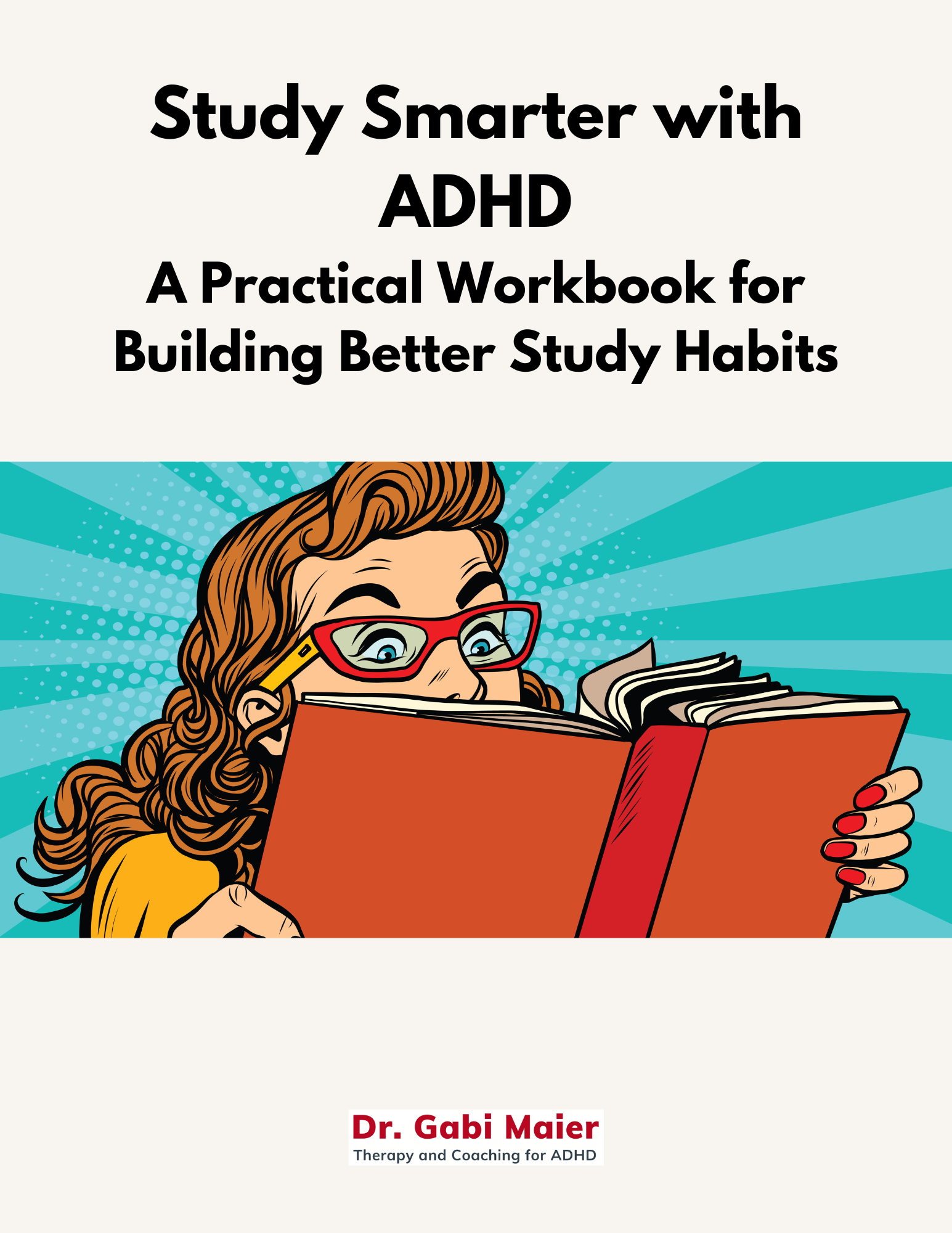
Want to make studying a little easier?
Knowing why studying can be difficult with ADHD is one thing. Figuring out what actually works for you is another.
I created Study Smarter with ADHD to help you take the next step. The free workbook walks you through practical ways to get started, create more structure, study more actively, and build habits that work better with your ADHD brain.
Get the free Study Smarter Workbook here
We don't suddenly have to become perfectly organized
Perhaps that's the most important point of all. If college feels overwhelming, we don't necessarily need more discipline. Sometimes we simply need more external structure, smaller steps, and systems that work with our brain. I probably would have benefited enormously from understanding that when I was a student. Instead, I somehow navigated my way through university with a lot of interest, even more energy, and a rather impressive collection of academic subjects. My path was anything but linear. But in the end, it still took me where I wanted to go.
So if we reach a point in college where the things that somehow worked before suddenly aren't enough anymore, it doesn't automatically mean we're not cut out for higher education. Perhaps the focus needs to shift from trying harder to organizing ourselves differently. And sometimes that shift in perspective is exactly what allows things to start working again.
Frequently Asked Questions
Why don’t we often detect ADHD until college?
College requires much more self-organization, long-term planning, and independence, while many of the external structures students relied on in school disappear. As a result, ADHD-related difficulties that were previously compensated for may become much more noticeable.
Can you have ADHD and still get good grades?
Yes. Academic success does not rule out ADHD. Some people develop highly effective compensation strategies or invest considerable amounts of time and energy in their work, making their difficulties almost invisible to others.
What do college students with ADHD commonly struggle with?
Common difficulties can include time management, organization, getting started on tasks, long-term planning, self-regulation, and managing distractions. However, ADHD affects people differently, and the degree of difficulty in each area varies considerably.
Why can studying right before an exam feel easier than studying weeks in advance?
An approaching deadline makes a task immediate, concrete, and urgent, which can make it easier to get started. Relying exclusively on last-minute urgency, however, can create considerable stress and lead to exhausting study periods.
What can help college students with ADHD?
Support should be individualized. Research on college students with ADHD has examined approaches including organizational and time-management training, ADHD coaching, CBT-based programs, and academic accommodations or university support services. Several approaches have shown promising results, although the research base is still developing.
Did this article resonate with you?
If you often find yourself struggling with ADHD and would like some support, I'd be happy to help. Together, we'll develop practical strategies that fit your life, your strengths, and your goals. In a free 30-minute consultation, we'll explore whether my approach is the right fit for you.
For teenagers (15+) and adults.
Enjoyed this article?
Every other week, I publish a new article with evidence-based insights and practical strategies to help you better understand and manage ADHD in everyday life.