Everything Is New, and I'm Exhausted: ADHD and Culture Shock

When I moved to Japan, I was thrilled. I was going to spend an entire year in a country I had never lived in before, improve my language skills, experience a different culture, and discover a completely new way of life. And I did love it. But there was something I hadn't expected: I was absolutely exhausted. For the first three or four months, I would come home at the end of the day feeling as though my brain had been working overtime. Even on days when I hadn't done anything particularly demanding. At first, I couldn't quite understand why.
Looking back, I think the answer is fairly simple. Almost everything around me required conscious effort. Listening, speaking, shopping, eating, navigating social situations — things that had previously happened almost automatically suddenly required attention. And when you are neurodivergent, that constant demand on your attention, working memory, and emotional regulation can make adjusting to a new country particularly challenging.
When everything around you is unfamiliar
We often think of culture shock as feeling homesick or being surprised by different customs. But culture shock can be much more subtle. It's the experience of no longer being able to rely on all the little things you used to know without thinking. How do I buy a train ticket? What am I supposed to say when I enter a store? Is this person being friendly, formal, or slightly annoyed? Why is everyone doing something differently from what I expected? Everyday life becomes a series of small puzzles.
Researchers refer to some of these challenges as acculturative stress: the psychological strain associated with adapting to a different cultural environment. Research involving international students has linked this stress with difficulties in psychological adjustment and well-being. Of course, culture shock isn't unique to ADHD. But ADHD can add another layer because many of the skills we rely on to navigate unfamiliar situations such as attention regulation, planning, working memory, and flexibility, may already require considerable effort.
Language fatigue: When listening becomes hard work
This was probably the biggest challenge for me in Japan. Japanese sounded completely different from the languages I was familiar with. When people spoke around me, I couldn't simply relax and let the sounds fade into the background. Everything sounded foreign. I found myself constantly trying to recognize words, understand conversations, and make sense of what was happening around me. Even when I wasn't actively participating in a conversation, my brain seemed to be working. After several hours, I was exhausted.
A few years later, I moved to Denmark, and the experience was remarkably different. Danish certainly doesn't sound like German. But as a German speaker who also knew English, I found something about the rhythm and general atmosphere of the language strangely familiar. When people were talking in the street, I didn't necessarily understand what they were saying. But the language didn't feel completely alien to me. In Japan, there was no such familiarity. I couldn't even pretend, for a moment, that I was home. And I think that difference mattered enormously.
Research on second-language listening supports the idea that processing an unfamiliar language can require substantial cognitive effort. A recent study also examined how language proficiency relates to listening-related fatigue among people using English as a second language. For people with ADHD, this may be especially relevant when sustained attention and filtering competing information are already challenging. Sometimes we aren't tired because we've done too much. We're tired because understanding everyday life has become a full-time job.
Sensory overload: Even the supermarket is an adventure
One of my favorite things about living in Japan was discovering the food. I remember walking through supermarkets and finding entire shelves of things I had never eaten before. Furikake. Rice cakes. Konnyaku. Enoki mushrooms. I was fascinated. What was this? How did you prepare it? What did it taste like? Was it sweet, salty, chewy, crunchy? And what exactly did the packaging say? I wanted to try everything.
But at the same time, I sometimes found the experience overwhelming. In Western countries, supermarkets may differ, but many products are recognizable. We know what bread looks like, where to find milk, and roughly what to expect from the breakfast cereal aisle. In Japan, I often had to start from scratch. Every shopping trip involved exploring, interpreting, deciding, and occasionally making rather interesting purchasing mistakes.
For someone who enjoys novelty, this can be wonderful. And many people with ADHD are drawn to new experiences and stimulating environments. But novelty also requires processing. Different sounds, unfamiliar smells, new foods, crowds, signs we can't read, and countless little decisions can quickly add up. Something that looks like a simple shopping trip from the outside may actually require a surprising amount of mental energy.
Decision fatigue: Nothing happens automatically anymore
Living abroad also means making decisions about things we barely noticed before. Which bank should I use? How do I register my address? Which phone contract makes sense? Where do I find a doctor? What documents do I need? And then there's the bureaucracy. Every country has its own rules, forms, procedures, and expectations. Often, the most difficult part isn't filling out a form. It's figuring out which form you need in the first place.
For someone with ADHD, this can become a perfect storm of executive-function demands. We need to gather information, remember instructions, compare options, organize documents, and follow through on several steps — sometimes in a language we don't fully understand. And unlike at home, we may not have established routines or familiar people to help us. The result can be decision fatigue: by the end of the day, even deciding what to cook for dinner feels like too much.
One of the most useful things we can do is reduce unnecessary decisions. Find a few familiar meals. Establish a regular grocery store. Create simple routines. Keep important documents in one place. Not because we need to become rigid but because familiarity gives our brain a chance to rest.
Emotional regulation: When curiosity turns into irritation
There was another aspect of living in Japan that I found fascinating, although my feelings about it changed over time. I was living in Kyushu, where I was quite visibly a foreigner. People would regularly approach me and ask questions. How old was I? Was I married? Where was I from? Sometimes people even asked whether they could touch my hair.
At first, I found these encounters amusing. They were unexpected, and I was curious about the cultural differences. But after a while, the same questions started becoming a little irritating. Sometimes I just wanted to go about my day without being noticed.
And that is another side of culture shock we don't always discuss. Something that initially feels interesting or charming can become frustrating when we encounter it repeatedly, especially when we're already tired.
ADHD can make this emotional balancing act more difficult for some people. Research has found associations between adult ADHD and difficulties with emotional regulation, although experiences vary considerably. We may be enthusiastic and curious one moment, then overwhelmed or irritable the next. That doesn't necessarily mean we dislike our new country. It may simply mean that our emotional resources are running low.
What can help when everything feels exhausting?
I think one of the biggest mistakes we can make when moving abroad is expecting ourselves to function at exactly the same level as before. We may have a new job, new friends, a new apartment, and an exciting new environment. But we also have far fewer automatic routines. So perhaps the first step is to recognize that adjustment itself requires energy. A few things can make a difference:
Build familiarity deliberately. Find a favorite café, a regular walking route, or a few familiar meals. Predictability can be restorative.
Give yourself language breaks. Spend time reading, listening, or talking in a language that feels effortless.
Reduce unnecessary decisions. Establish simple routines for shopping, meals, paperwork, and daily responsibilities.
Protect recovery time. You don't have to explore your new country every evening or accept every invitation.
Notice your emotional limits. Irritability or sudden frustration may be a sign that you need rest rather than another activity.
And perhaps most importantly, allow yourself to enjoy your new country without feeling obligated to enjoy every single moment of living there.
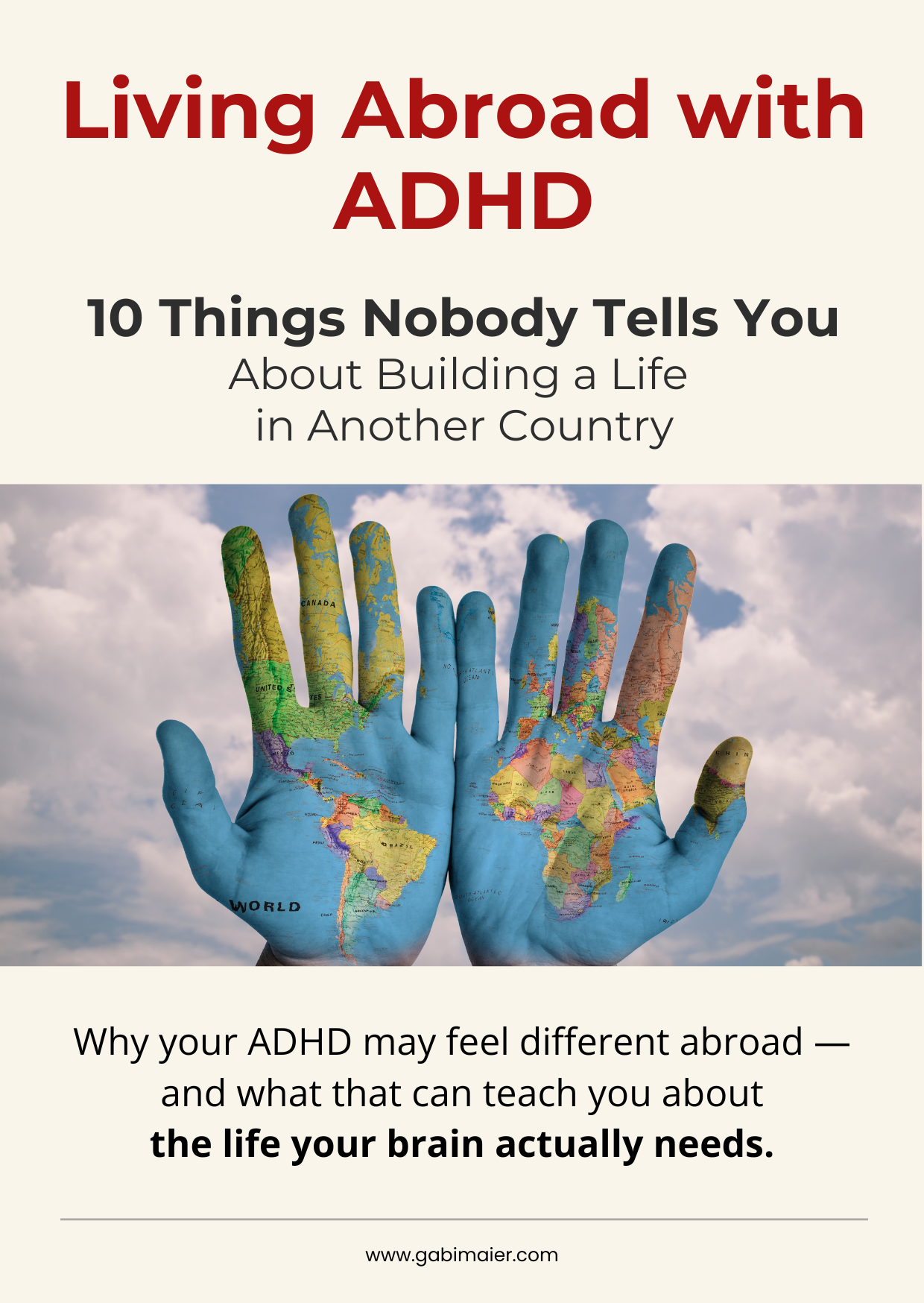
Living Abroad with ADHD? There’s More to the Story.
Moving to another country changes more than your address. It changes your routines, relationships, sense of belonging, and sometimes even the way you understand yourself.
I've created a free guide, Living Abroad with ADHD: 10 Things Nobody Tells You About Building a Life in Another Country, exploring some of the unexpected challenges and opportunities that come with starting over somewhere new.
Get the free guide here
The exhaustion doesn't mean you made the wrong decision
When I think back to my first months in Japan, I remember how tired I was. But I also remember how much I learned, how fascinating everyday life felt, and how deeply that experience influenced me. I wouldn't trade it for anything. Moving abroad can be one of the most stimulating and rewarding experiences of our lives. It can also demand more from our brains than we anticipate. And those two things aren't contradictory.
Sometimes we need time to develop familiarity, create routines, understand social expectations, and feel comfortable in a new language. Eventually, things that once required conscious effort may become second nature. The supermarket becomes familiar. Conversations become easier. We begin to understand the unwritten rules. And one day, we realize that we've made it through an entire day without having to think quite so hard about everything.
Perhaps adjusting to life abroad isn't about becoming better at handling constant novelty. It's about gradually creating enough familiarity that we can enjoy the novelty without being exhausted by it.
Frequently Asked Questions
Can ADHD make culture shock more difficult?
It can. Moving abroad often increases demands on attention, planning, working memory, and emotional regulation. For some people with ADHD, navigating unfamiliar routines, languages, and social expectations can therefore feel especially exhausting. However, everyone's experience is different.
Why am I so tired after moving to another country?
When you move abroad, many everyday activities require more conscious effort. Understanding conversations, making decisions, finding your way around, and interpreting unfamiliar social situations all consume mental energy. This adjustment process can be tiring even when you're enjoying your new life.
How long does culture shock last?
There is no fixed timeline. Some people begin feeling comfortable within a few months, while others need considerably longer. Adjustment also isn't necessarily linear: you may feel completely at home one week and unexpectedly overwhelmed the next.
Why is speaking a foreign language so exhausting with ADHD?
Speaking and listening in a less familiar language require sustained attention, working memory, and additional processing. When these demands are combined with ADHD-related attention difficulties, conversations can become particularly tiring. Regular breaks and opportunities to use a familiar language may help.
What can help with ADHD overwhelm when living abroad?
Start by reducing unnecessary demands. Establish a few predictable routines, create simple organizational systems, allow time to recover from social interactions, and avoid scheduling too many unfamiliar activities at once. Building familiarity can make everyday life feel more manageable.
Did this article resonate with you?
If you often find yourself struggling with ADHD and would like some support, I'd be happy to help. Together, we'll develop practical strategies that fit your life, your strengths, and your goals. In a free 30-minute consultation, we'll explore whether my approach is the right fit for you.
For teenagers (15+) and adults.
Enjoyed this article?
Every other week, I publish a new article with evidence-based insights and practical strategies to help you better understand and manage ADHD in everyday life.