Professional on the Outside, Exhausted on the Inside: ADHD Masking at Work
You’re sitting in a meeting that has been going on for an hour and a half. For the past thirty minutes, you’ve barely been able to follow what anyone is saying. Your eyes keep drifting toward the clock. Your leg is bouncing underneath the table. You would love to get up, move around, or at least check your phone for a minute. But you don’t. Instead, you sit there looking interested. You nod at the appropriate moments. You try desperately not to let anyone notice that your brain checked out a long time ago.
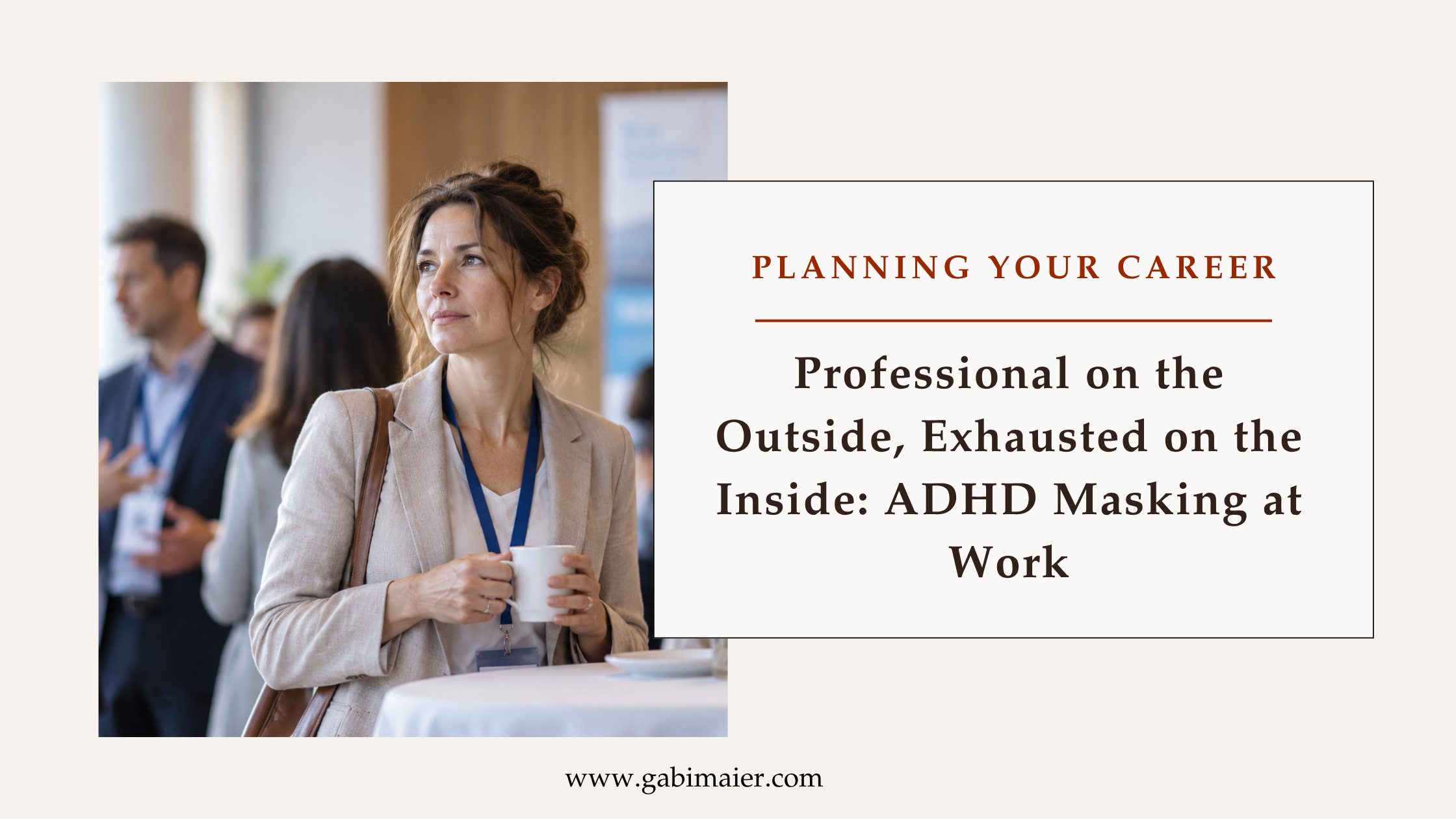
Or maybe you’re standing at a company event with a drink in your hand, making small talk for what feels like the fifth time that evening. Twenty people are talking around you. It’s loud. You’re finding it increasingly difficult to filter out the background noise and follow the person standing in front of you. What you really want is to go home. Instead, you smile. “Really? That’s so interesting!” And you stay for another hour. This can be ADHD masking.
What does ADHD masking actually mean?
The term masking first became widely known in connection with autism. More recently, however, researchers have also begun looking at the ways adults with ADHD hide, suppress, or compensate for their difficulties in order to meet social expectations. ADHD masking can take many different forms.
Maybe we suppress the urge to move around. We make a conscious effort not to interrupt. We write absolutely everything down because we don’t want anyone to realize how much we would otherwise forget. We arrive ridiculously early because we’re terrified of being late again. Perhaps we spend twice as long on an assignment as everyone else so that nobody sees how difficult it was for us to organize ourselves. Or we simply work very hard to appear calm, attentive, organized, and competent while our brain feels anything but.
Recent research into social camouflaging among adults with ADHD describes exactly these kinds of strategies: hiding or disguising difficulties, suppressing certain behaviors, and compensating for ADHD-related challenges. And the reasons people do it are remarkably human. We want to fit in. We want to be liked. We want to avoid criticism or negative reactions. And we want to function successfully in workplaces that are still largely built around neurotypical expectations.
The interesting thing is that masking can work surprisingly well. The problem is that nobody can see how exhausting it is. “But you don’t seem like someone with ADHD” Perhaps you’ve heard some version of this before. You seem organized. You have a good job. You meet your deadlines. You can sit quietly through a meeting. So your ADHD can’t really affect you that much, can it?
What people often don’t see is the amount of energy behind that apparent competence. Maybe you finished the presentation on time only because you worked on it until two in the morning. Maybe you looked attentive throughout the meeting but absorbed almost none of what was being said. Maybe writing that report took you twice as long as it took your colleagues. And maybe you come home after a normal workday and have absolutely nothing left.
Research with adults with ADHD suggests that alongside the potential social benefits of masking, there can be considerable costs, including exhaustion, psychological distress, and a reduced sense of authentic connection with other people. Masking may help us get through a situation successfully. The more important question might be: What does it cost us to do so?
For me, masking always depended heavily on the situation
When I worked as a professor at a university in the United States, large parts of my job suited me surprisingly well, especially teaching. When I was standing in front of my students, I didn’t have to work particularly hard at performing a professional version of myself. I could move around the classroom. I could respond spontaneously, ask questions, discuss ideas, and spend time thinking about subjects I found genuinely interesting. There were people right in front of me whom I could interact with directly. No class was exactly the same as the one before it. In that environment, masking was rarely an issue for me.
Of course, being a professor involved considerably more than teaching. Over the years, there seemed to be more and more meetings. Committee meetings. Department meetings. Faculty meetings. Meetings about things that would probably require another meeting. And there, things felt very different. Sitting still for long periods. Listening when I wasn’t particularly interested in the subject. Trying not to let my attention wander. Trying not to look impatient. Figuring out when it was appropriate to contribute and when it was better to stay quiet. In those situations, I was much more aware of masking.
The difference was even more noticeable at many professional social events, particularly academic conferences. I genuinely enjoyed meeting new people and having conversations about subjects that interested me. But conferences also meant receptions, dinners, networking events, and a tremendous amount of small talk. Lots of people. Lots of conversations. Lots of noise. And often for much longer than felt comfortable to me.
Eventually, I would reach the point where I really wanted to leave, but felt that everyone was expected to stay. So I stayed. I kept talking. I kept smiling. I kept trying to look interested and sociable. From the outside, nobody would necessarily have known that I was finding any of this particularly difficult. Yet, inside, I was increasingly thinking: Can I please go home now?
We may not mask equally in every environment
I think this distinction matters because it points to something that tends to get lost when we talk about ADHD: We don’t experience our ADHD in exactly the same way in every environment. And we don’t mask equally everywhere. Research on masking in the workplace has found masking behaviors not only among autistic and other neurodivergent adults but among neurotypical employees as well. Neurodivergent participants, however, described additional pressures related to navigating workplaces in which neurodivergence was often poorly understood. Masking could become a way of adapting in order to avoid negative social or professional consequences.
That fits remarkably well with my own experience. Today, I’m self-employed and fortunate enough to spend most of my working life doing things I genuinely enjoy. I work directly with people. I have in-depth conversations. I write. I develop new ideas. And I have a great deal of control over how I structure my working day. I hardly think about masking while I’m doing those things. Of course, I haven’t suddenly become less neurodivergent but my work simply fits me better.
And perhaps that is something we should talk about much more often. When work leaves us chronically exhausted, the question doesn’t always have to be: How can I get better at adapting? It may also be worth asking: How well does my work environment actually fit me? Because sometimes the answer isn’t becoming even better at hiding our needs. Sometimes we need a working environment in which we don’t have to hide them quite so much.
What does constant masking do to us?
Of course, we all adapt our behavior at work to some extent. That’s part of functioning in a professional environment. But it can become a problem when that adaptation consumes a significant amount of our energy. Imagine sitting in a meeting and not only trying to listen, but constantly monitoring yourself at the same time: Am I bouncing my leg again? Do I look interested enough? Have I talked too much? Should I say something now? Can anyone tell that I haven’t followed the conversation for the past ten minutes? In a sense, our brain is doing two jobs at once. We’re participating in the meeting while simultaneously watching ourselves participate in the meeting. Over time, that can be incredibly exhausting.
Research on masking and camouflaging among neurodivergent adults describes this downside as well. Masking may help people meet social expectations and avoid negative reactions, but it can also be associated with exhaustion, stress, and feeling unable to be fully yourself at work. That doesn’t mean we need to stop adapting altogether. Most of us probably couldn’t and wouldn’t want to. But it may be worth becoming more curious about one question: How much of my energy at work goes into appearing the way I think I’m supposed to appear?
Sometimes nobody sees what happens behind the scenes
Masking doesn’t only happen in meetings or social situations. It can also show up in the way we get our work done. Maybe our colleagues think of us as reliable. Our presentations are good. We meet our deadlines. From the outside, everything seems to be working. What nobody sees is that we spent three days trying to start the task. Then, when the deadline became urgent enough, we sat at our desk until midnight and somehow managed to finish the presentation just in time.
This is one reason an ADHD diagnosis in adulthood can sometimes come as such a surprise to the people around us. But you went to university. You have a successful career. You’re so organized. All of that may be true. But perhaps the more interesting question is: How much did it cost you to make it look that way?
Feeling Overwhelmed after a Long Workday?
Constantly monitoring yourself, managing distractions, and trying to meet other people's expectations can leave you with very little energy at the end of the day.
I created a free DBT Skills Guide with practical strategies for managing overwhelming emotions, reducing stress, and getting through difficult moments without simply pushing yourself harder.
→ Download the Free DBT Skills Guide here
Maybe ADHD isn't the only problem
This has become one of the aspects of ADHD that interests me most. When we talk about ADHD, the conversation often focuses on what we should do better. We should become more organized. More punctual. More focused. Less impulsive. Better at prioritizing. Better at managing our time. And yes, strategies that help us develop these skills can be incredibly useful. But sometimes I wonder whether we’re asking the question in the wrong direction. Instead of only asking: How can I fit into this workplace better? we might also ask: How could this workplace fit me better?
Research on ADHD and employment increasingly points to the importance of the fit between a person and their working environment. Autonomy, flexibility, clear structures, interesting or meaningful tasks, and appropriate support can all influence how effectively someone with ADHD is able to use their strengths at work. And improving that fit doesn’t necessarily require enormous changes. Maybe you can stand or walk around during an online meeting rather than forcing yourself to sit still. Maybe you need 15 minutes without interaction after several meetings in a row. Maybe written instructions work much better for you than a request casually mentioned in conversation. Maybe you concentrate better at home than in an open-plan office. Maybe you need uninterrupted blocks of time rather than being expected to respond to messages throughout the day. What helps will look different for everyone. The point isn’t to create the mythical “perfect ADHD workplace” but to start noticing which conditions make it easier - or harder - for your brain to do its job.
Less masking doesn't mean changing everything
Of course, most of us can’t simply quit our jobs and design a perfect working environment from scratch. And that isn’t the point. Change can start much smaller. For one week, you could simply pay attention to the situations in which you spend a lot of energy adapting, suppressing, compensating, or hiding something at work. Not because you need to stop doing those things immediately. Just notice them.
You may discover that the work itself isn’t actually what exhausts you most. Maybe it’s the constant interruptions. The social expectations. The open-plan office. The endless meetings. But you may also notice something else. There might be certain tasks during which you barely mask at all. Perhaps you become focused, creative, spontaneous, curious, or completely absorbed in what you’re doing. Maybe you can talk enthusiastically about an idea without monitoring every word. Maybe you work for two hours and suddenly realize you haven’t thought about how you’re coming across even once. I find those moments at least as interesting as the difficult ones. Because they tell us something important about the conditions under which we function well.
Maybe we don't need to get better at fitting in
Masking isn’t inherently bad. There will always be situations in which we adjust our behavior to the people and environment around us. Sometimes masking may even help us navigate a difficult situation, protect our privacy, or feel more comfortable professionally. But if we spend a substantial part of every workday controlling our natural reactions, hiding our difficulties, and maintaining an outward version of ourselves that appears to function effortlessly, the cost can become very high.
So while I think “How can I mask less?” is a useful question, there may be an even more interesting one: Where do I hardly need to mask at all?
Who are the people around whom we feel comfortable?
Which tasks come more naturally to us?
What working conditions help us stay focused?
When are we able to move, think deeply, be spontaneous, get excited about an idea, or work intensely without constantly monitoring ourselves?
Those questions shift the focus. Instead of only looking for everything that is difficult about our ADHD, we begin looking for the environments in which our brains work well. And perhaps that’s where meaningful change can begin.
We can start figuring out what our brains actually need from a working environment, and which small changes might make our days more sustainable. Because the goal shouldn’t be to become so good at masking that nobody notices how much our workday costs us. The goal should be to create a working life that doesn't have to cost us quite so much.
Frequently Asked Questions
What does masking mean in ADHD?
ADHD masking means consciously or unconsciously hiding, suppressing, or compensating for ADHD-related behaviors and difficulties in order to meet social or professional expectations. For example, we might suppress the urge to move, make a conscious effort not to interrupt, or work particularly hard to appear organized even when doing so requires a great deal of energy.
What does ADHD masking look like at work?
ADHD masking can look very different from one person to another. Some people force themselves to sit completely still and appear attentive during long meetings. Others closely monitor themselves in conversations, overprepare for tasks, continue working after hours, or create elaborate systems so that nobody notices how difficult they find organization, concentration, or time management.
Why can ADHD masking be so exhausting?
Constantly monitoring how we appear to others and suppressing our natural reactions requires additional mental effort. Research on masking among neurodivergent adults has associated it with experiences such as exhaustion and psychological distress. How exhausting masking becomes may also depend on how well our working environment fits our individual needs.
Is all professional behavior at work a form of masking?
No. Everyone adjusts their behavior depending on the situation. Choosing not to say everything we're thinking during a meeting or preparing carefully for an important conversation isn't necessarily masking. It becomes more relevant when we spend a significant part of our working day hiding difficulties or needs and find that this constant self-monitoring leaves us increasingly exhausted.
How can I mask less at work?
We don't necessarily need to stop all masking behaviors overnight. A more useful first step may be to notice when we mask most and what makes us feel that we need to. Perhaps we need more movement between meetings, fewer interruptions, clearer expectations, greater autonomy, or somewhere quiet to work. Sometimes a different role or working environment may simply be a much better fit.
Did this article resonate with you?
If you often find yourself struggling with ADHD and would like some support, I'd be happy to help. Together, we'll develop practical strategies that fit your life, your strengths, and your goals. In a free 30-minute consultation, we'll explore whether my approach is the right fit for you.
For teenagers (15+) and adults.
Enjoyed this article?
Every other week, I publish a new article with evidence-based insights and practical strategies to help you better understand and manage ADHD in everyday life.