The ADHD Learning Trap: When Too Many Strategies Kill Action
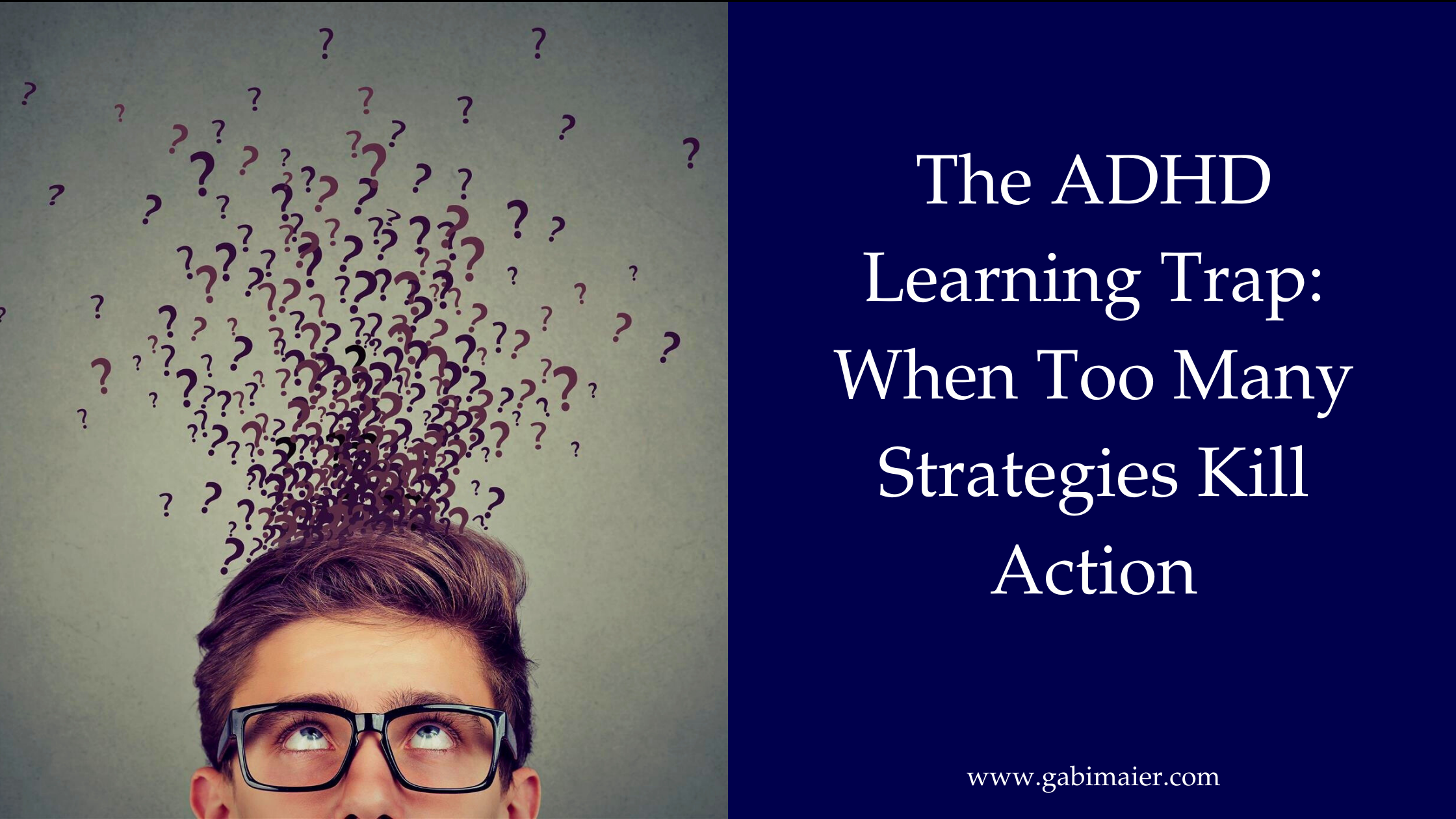
Many of us with ADHD know this experience intimately: on paper, we know what would help us. Pomodoro. Body doubling. Active recall. Spaced repetition. Flashcards. Apps. Timers. Routines. And the list goes on and on. We’ve done our homework, watched all the videos, saved the posts, listened to the podcasts. In theory, we are extremely well informed.
And yet, when it comes time to sit down and actually do the work, nothing happens. What comes up instead is a familiar, painful thought: “I know what I should be doing. I just can’t get myself to do it.”
This gap between knowing and doing is one of the most misunderstood aspects of ADHD, at least in my experience as an ADHD-coach. It’s also where a lot of unnecessary shame creeps in. We start to believe that we must be lazy, unmotivated, or lacking discipline, especially when everyone else seems to be thriving on the very methods that don’t work for us.
But here’s the truth:
The problem is not a lack of knowledge.
The problem is a lack of translation.
Why too many methods become a problem
ADHD brains are often excellent at absorbing information. We’re curious, pattern-oriented, and quick to recognize promising ideas. That’s why learning strategies are so compelling in the first place. Each new method feels like hope and we start to believe that this one might finally be the thing that will make everything easier.
The trouble begins when all of these methods coexist in our mind without hierarchy, without adaptation, and without integration into our real life. Instead of providing clarity, they start competing for our attention.
From a neuropsychological perspective, this makes perfect sense. ADHD is commonly associated with challenges in executive functioning, especially planning, prioritizing, initiating tasks, and making decisions under cognitive load. When our brain is holding ten different “good” strategies at once, it doesn’t produce motivation. It produces paralysis.
Instead of “I’ll start now,” the internal dialogue sounds more like:
Which method should I use? Am I supposed to do Pomodoro or active recall? Should I set up flashcards first? Maybe I should organize my notes better before I begin…
Nothing is wrong with us. The system is simply too complex.
Why information doesn’t automatically lead to action
One of the biggest myths around learning, especially in productivity culture, is the idea that once we understand what to do, we’ll naturally do it. That assumption might work for linear systems. It rarely works for ADHD.
Between “I know this method” and “I’m using this method” lie several invisible steps: emotional readiness, nervous system regulation, perceived effort, internal resistance, and the question of whether something actually fits into our life as it is — not as we wish it were.
Most learning methods quietly assume that we as the the learner are already regulated, confident, consistent, and able to recover easily from setbacks. For many of us with ADHD, those are precisely the areas that feel most fragile.
So when a method doesn’t work for us, it’s not because the method is bad or because we failed. It’s because the method was never translated into something livable.
Translation, not optimization
What’s missing isn’t another tool. It’s a process of interpretation. Translation means asking: What does this method look like in my body, my schedule, my energy level, my nervous system?
Let’s take Pomodoro as an example. It’s often presented as 25 minutes of focused work followed by a 5-minute break. For some of us with ADHD, that’s perfect. For many others, it’s not. 25 minutes may feel impossibly long at the beginning, or frustratingly short once focus finally kicks in.
Translation might mean abandoning the numbers entirely and keeping only the core idea: working in contained chunks. That could look like 10 minutes of effort followed by stopping before overwhelm hits us. The principle stays intact, but the pressure disappears. That’s what translation does: it strips methods down to their essence and reshapes them to fit reality.
Why less is usually more
Another hard truth is that our ADHD brains rarely benefit from accumulation. More apps, more planners, more systems often create more mental noise rather than more clarity. Implementation tends to improve when the number of decisions decreases. When expectations are low and clear. When the starting point is intentionally easy.
That’s why it can be so powerful to choose one strategy for a limited period of time. Not because it’s the objectively best method, but because it gives our brain orientation. Stability matters more than optimization. Instead of trying to combine Pomodoro, spaced repetition, and flashcards all at once, it’s often more effective to say: For the next two weeks, I’ll do one simple thing even if I do it imperfectly. Reduction is not giving up. It’s creating conditions where action becomes possible.
Implementation starts before learning
One of the most overlooked aspects of learning with ADHD is the state of the nervous system. Many of us attempt to study while already overwhelmed, tense, or internally resistant. In that state, no technique will work reliably. That’s why strategies like body doubling are so effective, not because of the presence of another person per se, but because they regulate our nervous system. They reduce threat, create structure, and make focus feel safer.
Once we understand that, we can stop chasing the method and start recreating the underlying condition - whether through environment, rhythm, or support.
A different question changes everything
Instead of asking, Why can’t I make myself do this? a more helpful question is: What is getting in the way of implementation right now? Often the answer is surprisingly simple:
The task is too big.
The first step is unclear.
The emotional cost feels too high.
Perfectionism is quietly shutting everything down.
For people with ADHD, implementation is rarely a motivation problem. It’s a fit problem.
Fewer methods, more meaning
We don’t need more learning hacks. We need spaces where information is slowed down, contextualized, and adapted. Where it’s acceptable to simplify, discard, or do things “the wrong way” if that’s what works.
If we feel like we already know everything but still can’t move forward, that doesn’t mean we’re broken. It means our brain doesn’t need more input. It needs support with translation. Not more methods but fewer that actually fit.
And sometimes, the most important step isn’t learning something new at all, but allowing ourselves to start with what feels possible right now.
If you need additional help and support with your ADHD symptoms reach out anytime and book a free discovery call with me.
And if you like to stay up-to-date on my future blog posts, subscribe to my newsletter: