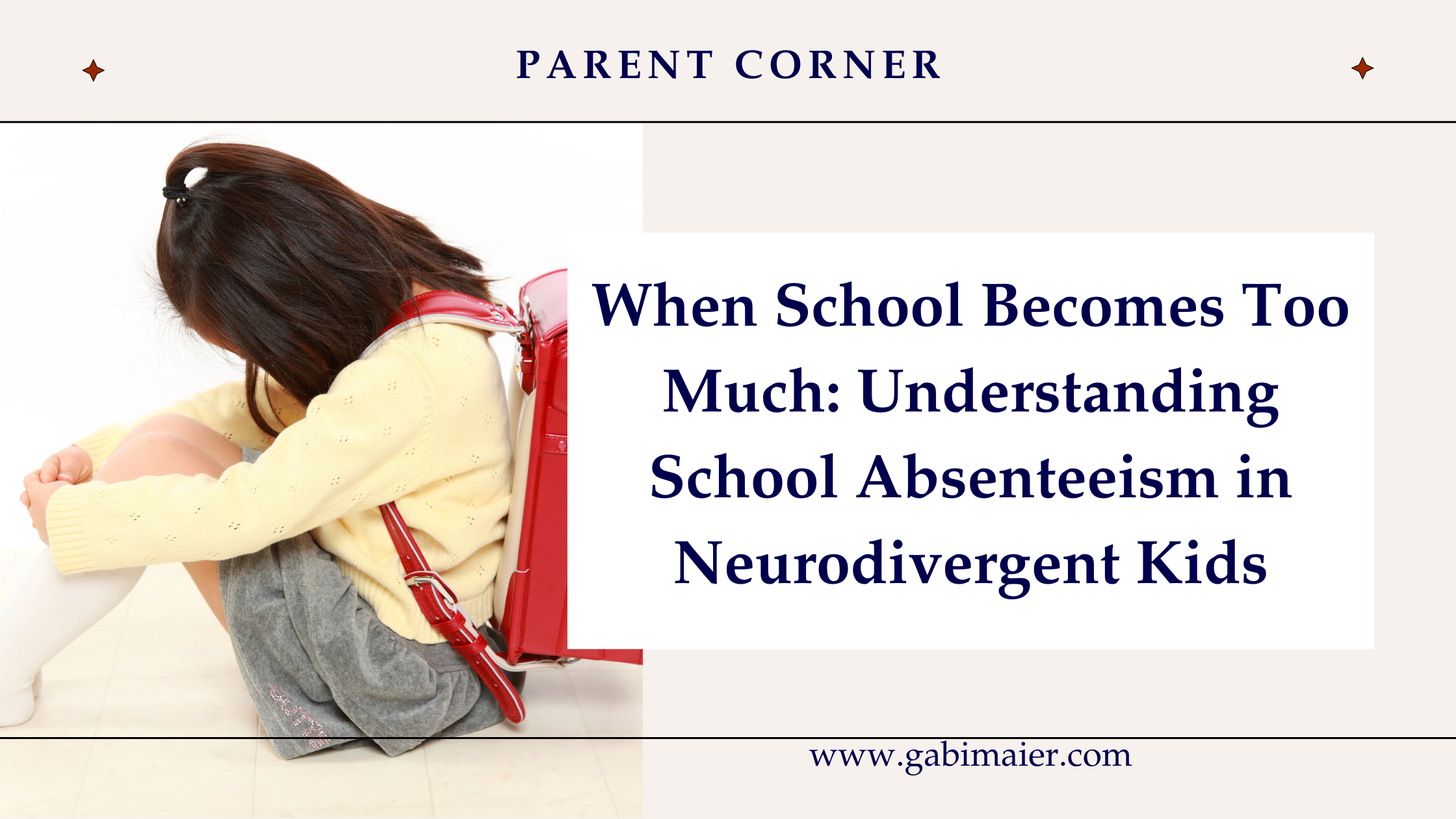
I give quite a few workshops and seminars every year. One of the topics I return to again and again is how neurodivergent kids can be successful in school. And almost without exception, there’s a group of parents sitting in the room who aren’t just looking for “success strategies.” They’re in complete crisis because their children are refusing to go to school.
You can feel the weight of it immediately. The exhaustion. The worry. The quiet panic. Because here in Germany, we have Schulpflicht which translates to compulsory school attendance or mandatory schooling. It means that children are legally required to attend school. And while that sounds reasonable in theory, in practice it can leave families feeling completely trapped when a child simply cannot cope with the system. There are very few alternatives, little flexibility, and a lot of pressure.
When kids don’t fit the system
School absenteeism doesn’t look the same for every child. Some kids struggle from the very beginning. The transition into kindergarten or first grade already feels overwhelming, confusing, or even threatening. Like with my oldest son who never ever liked going to day-care, pre-school or regular school.
Others do okay at first until they don’t. Maybe the academic demands increase. Maybe grades start slipping. Maybe they realize they can’t keep up, no matter how hard they try. What starts as mild discomfort can quickly spiral into anxiety, avoidance, and eventually complete refusal. And here’s the painful part: Often, there is no real help. Instead, kids are labeled:
lazy
unmotivated
defiant
Parents aren’t spared either. They’re told they’re too lenient, too protective, not consistent enough. And the “solution”? Force the child back into school. Rarely do we see genuine, collaborative conversations where everyone - parents, teachers, and most importantly the child - comes together to understand what’s actually going on and to find real, workable solutions.
Why neurodivergent kids are especially affected
School absenteeism is particularly common among neurodivergent children. And for very good reasons. Let’s name a few:
Overstimulation
Classrooms are loud, busy, unpredictable places. For kids with sensory sensitivities, this can feel unbearable. The constant noise, movement, and social demands can push their nervous system into overload.
Boredom
Many neurodivergent kids, especially those with ADHD, struggle when learning isn’t engaging. If the pace is too slow, or the material feels irrelevant, their brain simply checks out.
Feeling “wrong”
If you’re constantly corrected, misunderstood, or compared to others, you start to internalize a painful message: Something is wrong with me. That feeling alone can make school feel unsafe.
Academic frustration
Children with learning differences like dyslexia or dyscalculia often work twice as hard for half the results. Without proper accommodations, school becomes a place of repeated failure.
Social overwhelm
Navigating friendships, group dynamics, and unspoken social rules is exhausting, especially for autistic kids or those with social anxiety.
When you put all of that together, school isn’t just “a bit hard.” For some kids, it becomes intolerable.
A personal story
This is not just something I see in my work. It’s something I live. My son has always struggled with institutions. Daycare, school, sports clubs - anything structured, organized, and full of people has felt overwhelming to him. Even activities that are supposed to be fun like school celebrations, excursions, carnival can be too much. If there are too many kids and too much noise, he simply can’t do it. And it’s not just about sensory overload.
He’s also often bored in school. At the same time, he’s overwhelmed in a classroom with 30 other children. He has been misunderstood by teachers who interpret his behavior as laziness even though he has official diagnoses of dyslexia and dyscalculia. He doesn’t perform well on tests. He receives very few accommodations. And the constant experience of getting bad grades has been deeply frustrating and discouraging for him.
He still goes to school every day but only with me and he only sits in the quiet room for kids who are overwhelmed and need time to calm down. At the moment he is unable to enter his classroom. Not because he doesn’t want to but because he can’t. There’s fear. There’s overwhelm. There’s his nervous system saying: This is too much.
So what are the options?
This is where things get complicated. Many parents start looking for alternatives from the regular school system:
Waldorf or Montessori schools
These can be wonderful environments but they’re not automatically better for neurodivergent kids. Some children need more structure, not less.
More independent schools
These often emphasize self-directed learning. That can be great for some kids but overwhelming for others who struggle with executive functioning.
Homeschooling or online schooling
In many countries, this is a valid option. In Germany, it’s largely not allowed.
Even where it is allowed, it’s not always a perfect solution:
Some kids (like my son) have zero motivation for school at home
It can lead to constant conflict
Not every parent has the time, energy, or financial flexibility
Unschooling
A beautiful concept in theory but it requires enormous resources, time, and trust. It’s simply not realistic for many families.
So we’re often left in a space between two extremes:
rigid traditional schools or
highly independent alternative models
And neither fits quite right.
What can we do when a child refuses school?
This is the question I get asked the most. And I wish there were a simple answer but unfortunately, there isn’t. Yet, there are ways forward.
1. Shift from “Why won’t they?” to “What’s going on?”
When we ask “Why won’t they just go?”, we’re often (without meaning to) framing the child as the problem. A more helpful question is: What is making school feel impossible right now? This shift moves us from blame into curiosity. It opens the door to understanding whether the issue is anxiety, sensory overload, learning struggles, or something else entirely.
2. Take your child seriously
Even if your child can’t fully explain what’s wrong, their distress is real. Statements like “It’s not that bad” or “You have to go anyway” may shut down communication. Instead, try reflecting what you see: “It looks like this feels really hard for you.” Feeling understood often reduces resistance more than any argument ever could.
3. Reduce pressure where possible
With compulsory school attendance, completely removing pressure isn’t realistic but we can soften it. That might mean adjusting expectations at home, pausing extra activities, or accepting that attendance might not look “perfect” right now. Sometimes, taking a step back is what allows a child to move forward again.
4. Build alliances with teachers
This can feel intimidating, especially if previous conversations haven’t gone well. But when possible, approach teachers with a collaborative mindset: “We’re trying to understand what’s going on. Can we think this through together?” Share insights about your child that may not be visible in the classroom. Even one supportive adult at school can make a huge difference. At least, that’s been our experience so far, working together with the principal, teachers, special ed experts to figure problems out together. It’s sometimes challenging but it’s been more successful than doing it all on our own.
5. Ask for accommodations (and keep asking)
Many neurodivergent kids are technically entitled to support but in reality, parents often have to advocate persistently. Be specific about what might help: shorter assignments, extra time, movement breaks, or a quieter workspace. If something doesn’t work, it’s okay to revisit and adjust. This is often a process, not a one-time fix. Again, involve experts such as therapists or learning specialists to help you advocate for your child. Outside expertise might be more powerful than your own explanations and add more weight to your requests.
6. Focus on regulation before academics
When a child is overwhelmed, anxious, or shut down, learning simply isn’t accessible. In those moments, the goal is not math or spelling; it’s helping the nervous system feel safe again. That could look like taking a break, going for a walk, or just sitting together quietly. Once regulation returns, learning becomes possible again.
7. Create predictable routines
Even if your child resists school, having a consistent rhythm to the day can reduce anxiety. Knowing what comes next creates a sense of safety and control. Keep routines simple and realistic, especially in the morning, when stress levels are often highest. Visual schedules or gentle reminders can also help.
8. Break things into smaller steps
“Go to school” can feel like an overwhelming, impossible demand. Breaking it down makes it more manageable: first getting dressed, then leaving the house, then entering the building. Some days, success might mean just making it to the school gate or staying for 10 minutes in the classroom. Small steps build trust and confidence over time.
9. Celebrate tiny wins
Progress in these situations is often slow and non-linear. If your child manages something they couldn’t do yesterday, even if it seems small, that matters. Naming and celebrating these moments helps shift the focus from failure to growth. It also shows your child that effort is seen and valued.
10. Get external support
You don’t have to figure this out on your own. Therapists, ADHD coaches, school psychologists, or support groups can bring new perspectives and strategies. Sometimes, kids also open up differently to someone outside the family. And for parents, having support can make this whole situation feel less isolating.
11. Protect your relationship
When school becomes a daily battleground, it can quickly damage the parent-child connection. Try to create moments that are not about school at all and give your child the feeling of acceptance and safety. Your relationship is the foundation for everything else. Without it, even the best strategies won’t land.
12. Stay curious, not judgmental (towards yourself, too)
It’s easy to fall into self-doubt or feel like you’re doing everything wrong. But this is complex, and there is no perfect roadmap. Try to approach both your child and yourself with curiosity instead of criticism. You are learning as you go and that is enough.
You are not failing
If you’re in this situation right now, I want you to hear this: You are not failing. Your child is not broken. What you’re seeing makes sense when you look closely enough. School absenteeism is not about laziness or defiance. It’s about a mismatch between a child and a system that wasn’t designed with them in mind.
And while we may not always be able to change the system overnight, we can change how we respond.
· With patience.
· With curiosity.
· With compassion.
And sometimes, that’s where real change begins.
If you need help and support with your ADHD symptoms, book a free discovery call - and we can figure it out together!
And if you like to stay up-to-date on my future blog posts, subscribe to my newsletter: